
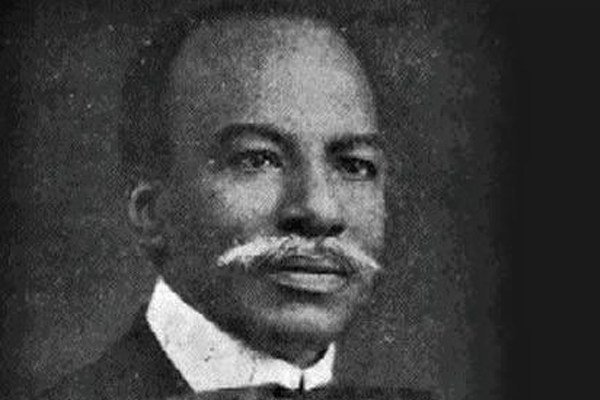
The story of Herbert Macaulay begins not on a battlefield or in a great hall, but in the quiet prestige of an educated Lagos family.
Born Olayinka Herbert Samuel Heelas Badmus Macaulay in 1864, his destiny was rooted in an exceptional lineage: his father founded the CMS Grammar School, and his maternal grandfather was Bishop Samuel Ajayi Crowther, the first African bishop.
Macaulay, sharp and brilliant, earned a government scholarship that took him to Plymouth, England, in 1890.
There, he trained as a Civil Engineer, becoming the first Nigerian to hold such a qualification. He returned to the Lagos Colony in 1893, taking up a respected post as a Surveyor of Crown Lands. Yet, the honor of service soon soured.
He observed the deep, insulting canyon of “racial discrimination”—a gulf symbolized by the colonial government paying a junior European far more than an educated African like himself.
By 1898, he had resigned, turning his back forever on the British authority he was trained to serve.
From an architect of colonial infrastructure, Macaulay swiftly became the architect of its destruction.
The weapon he chose was the pen, wielding it in the pages of the Lagos Daily Times and later his own platform, the Lagos Daily News.
Through scathing editorials, he turned every injustice—from the unfair water rates of 1915 to colonial land grabs—into a rallying cry for the masses.
His fame exploded following what became known as the Eleko Affair.
In 1921, Macaulay traveled to London to represent the Eleko (King) of Lagos, Chief Oluwa, in a fierce legal battle over land ownership.
Standing before the Privy Council, Macaulay successfully proclaimed that the British colonial government was “eroding the power and authority of the Eleko,” whom he insisted was “recognized by all Nigerians as the rightful king of Lagos.”
When the verdict came back in favor of the chief, paying compensation for the seized lands, Macaulay was hailed as a triumphant defender of the people, and the political lines in Lagos were forever hardened.
Seizing the momentum, in 1923, Macaulay founded the Nigerian National Democratic Party (NNDP), the nation’s first political party.
Though his past legal troubles meant he himself was barred from holding office, he masterfully ran the party from behind the scenes, ensuring its candidates swept the elections for the African seats in the Legislative Council for over a decade.
As he entered his final years, Macaulay realized that the fight had to grow beyond Lagos. In 1944, he joined forces with the younger, fiery Dr. Nnamdi Azikiwe to co-found the National Council of Nigeria and the Cameroons (NCNC).
This union forged the first truly national, mass-based political organization, uniting over forty diverse groups to press for one singular goal: independence.
Despite his advanced age, Macaulay took on the mantle of NCNC President and bravely embarked on a grueling, nationwide campaign tour in 1946.
It was in Kano, on this journey to unite the nation, that the eighty-one-year-old leader fell gravely ill. He was rushed back to Lagos, where he passed away on May 7, 1946.
Macaulay did not live to see the 1960 dawn of freedom he fought for, yet his legacy was secured.
His funeral was a massive outpouring of national grief, and his name, Herbert Macaulay, was forever enshrined as the “Father of Nigerian Nationalism,” a reminder that the struggle for independence was built on the foundation laid by a brilliant engineer who chose to dismantle colonialism.


