
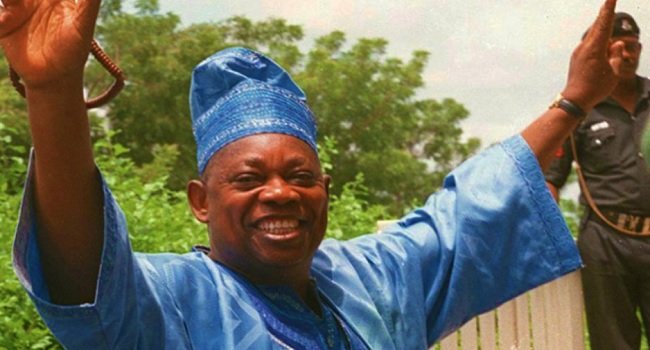
Moshood Kashimawo Olawale Abiola began his life not as a magnate or a politician, but as a child with an inherited moniker: Kashimawo, meaning “let us wait and see.”
Born in Abeokuta in 1937, he was the twenty-third child his father had sired, but the first to survive infancy, prompting that cautious name.
His early years were defined by grit; to help his family survive poverty, the nine-year-old rose before dawn to sell firewood gathered from the forest, an early sign of the entrepreneurial spirit that would define him.
He earned enough from his small-scale ventures—including forming a band at fifteen—to support his education and later pursue higher studies in accountancy in Glasgow, Scotland.
Upon his return to Nigeria, Abiola rapidly ascended the corporate ladder, culminating in his role as the Vice-President of ITT Corporation for Africa and the Middle East.
He built an empire encompassing publishing (Concord Press), banking, oil, and aviation, becoming a globally recognized businessman and a legendary philanthropist whose generosity spanned all of Nigeria’s ethnic and religious groups.
His vast network and openhandedness made him a figure of immense national stature.
This national fame paved the way for his boldest endeavor: politics. In 1993, he threw his hat into the presidential race under the banner of the Social Democratic Party (SDP) with the slogan “Hope ’93.”
His candidacy represented a genuine cross-sectional unity, an aspiration that transcended Nigeria’s notorious ethnic and religious fault lines.
A Southern Muslim, he chose a Northern Muslim, Baba Gana Kingibe, as his running mate, a political maneuver that helped him secure overwhelming support across the entire country.
On June 12, 1993, Nigerians went to the polls. The election was immediately lauded as the freest and fairest in the nation’s history.
The unofficial results showed that M.K.O. Abiola had won decisively, garnering victory in 19 of the 30 states, including his opponent’s home state. The hope he promised seemed tangible; the waiting was over.
But the celebration was short-lived.
Before the final official tally could be announced, the military regime of General Ibrahim Babangida (IBB) shockingly annulled the election on June 24, 1993. T
he decision, shrouded in ambiguous excuses about “electoral irregularities,” plunged the nation into a constitutional and political crisis.
Abiola refused to let his mandate be stolen. After briefly leaving the country, he returned in 1994 and, in the Epetedo area of Lagos, boldly declared himself the legitimate President of Nigeria.
The new military regime, headed by General Sani Abacha, retaliated swiftly, charging Abiola with treason and arresting him.
M.K.O. Abiola spent the next four years imprisoned, refusing to renounce his mandate even as his incarceration triggered intense civil unrest, international sanctions, and a prolonged struggle against military rule. He became the defiant, enduring symbol of Nigerian democracy.
His tragic story reached its climax in July 1998. Days after the sudden death of General Sani Abacha, and on the very day that international figures, including a U.S. delegation, were meeting with him to discuss his imminent release, M.K.O. Abiola collapsed and died in detention.
The official cause was heart failure, but the circumstances sparked outrage and reinforced the nation’s sense of loss.
He had survived twenty-two of his father’s twenty-three children, only to have his mandate—and his life—abruptly ended.
Decades later, in a significant act of official recognition, the Nigerian government acknowledged the injustice.
In 2018, the Federal Government posthumously awarded M.K.O. Abiola the Grand Commander of the Federal Republic (GCFR), the country’s highest honour, and officially declared June 12 as Nigeria’s Democracy Day, securing his legacy as the man who paid the ultimate price for Nigerian democracy.


