
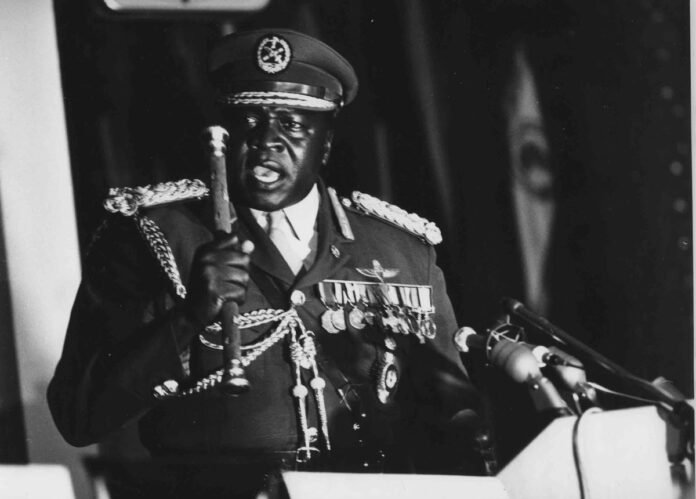
The man who would become known as the “Butcher of Uganda” began his life far from the world of power, born into poverty in the isolated corners of northwest Uganda around 1925 (the exact date is unconfirmed).
With very little formal education, the towering, physically imposing Idi Amin Dada Oumee found his calling in the military, enlisting in the British colonial army’s King’s African Rifles (KAR) in 1946, starting his service possibly as an assistant cook.
He was an exceptional athlete, dominating the ring as the Ugandan light-heavyweight boxing champion from 1951 to 1960.
He rose through the ranks, becoming one of the few Africans to be promoted to a commissioned officer rank before Uganda gained independence in 1962, and quickly became closely associated with Uganda’s first Prime Minister, Milton Obote, who made him commander of the army and air force in 1966.
Yet, the alliance frayed into suspicion; sensing that Obote planned to arrest him for misappropriating army funds, Amin staged a successful military coup on January 25, 1971, while Obote was attending a meeting abroad. Amin declared himself President, and eventually Life President in 1976.
Amin’s rule quickly devolved into a nightmare characterized by an extreme mix of populist charm and staggering brutality, political repression, and mass killings.
He quickly began mass killings, initially targeting ethnic groups perceived as loyal to Obote (predominantly the Acholi and Lango), but his victims eventually came from all sectors of society. Estimates of those killed under his regime range widely, from 100,000 to 500,000 people.
In 1972, Amin ordered the expulsion of approximately 40,000 to 50,000 Indian businesspeople from Uganda, accusing them of “milking Uganda’s money.”
This action led to the catastrophic collapse of the Ugandan economy, as these Asians controlled the majority of the nation’s businesses and tax revenue.
His erratic international antics included cutting ties with Israel (who had initially supported him) and Great Britain and becoming infamous for supporting the hijackers of an Air France flight to Entebbe in 1976, which led to a dramatic and successful counter-terror raid by Israeli commandos.
The end of his tyranny came in October 1978, when Amin launched a reckless and ill-advised attack on a disputed region of neighboring Tanzania.
Tanzanian President Julius Nyerere retaliated by ordering troops to invade Uganda, aided by Ugandan nationalist exiles.
As the Tanzanian-led forces neared the capital, Kampala, Amin was forced to flee the country in April 1979.
He was never tried for the atrocities committed during his rule, instead finding refuge first in Libya and then settling in Saudi Arabia, where he lived in exile for the rest of his life.
Idi Amin died in Jeddah, Saudi Arabia, on August 16, 2003, leaving behind a legacy as one of the most ruthless dictators in modern history, whose eight-year regime left Uganda economically devastated and permanently scarred by mass atrocities.


