
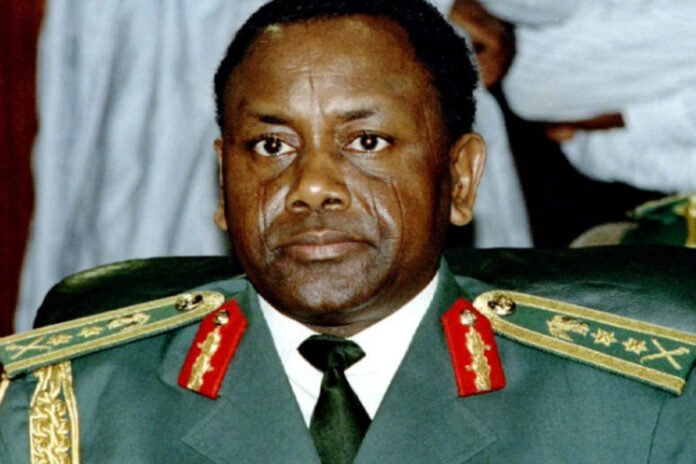
The destiny of General Sani Abacha was forged in the inner workings of the Nigerian military, a world of coups, decrees, and shifting loyalties. Born in 1943, Abacha methodically climbed the military ranks, eventually achieving the unique distinction of being the first Nigerian Army officer to reach the rank of a full General without skipping a single rank.
His involvement in Nigeria’s turbulent political history was deep: he participated in the 1983 coup that brought Muhammadu Buhari to power and, two years later, played a crucial role in the coup that installed Ibrahim Babangida. By 1993, he had attained the powerful post of Minister of Defence.
The moment Abacha seized his own power came in November 1993.
Following the political chaos unleashed by the annulment of the June 12, 1993, presidential election won by Moshood K. O. Abiola, Abacha orchestrated a swift and bloodless coup, removing the weak interim government.
He declared himself the Head of State and Commander-in-Chief of the Armed Forces, marking the final successful military takeover in Nigeria’s history.
His rule, which lasted four and a half years, quickly became one of the most draconian periods in the nation’s history.
Abacha moved immediately to dissolve all democratic institutions and installed himself as an absolute ruler, issuing decrees that placed his authority above the jurisdiction of the courts.
Any semblance of opposition was crushed: pro-democracy activists were jailed, high-profile figures like former Head of State Olusegun Obasanjo were imprisoned on charges of treason, and the legitimate winner of the 1993 election, Moshood Abiola, was detained for declaring himself president.
The peak of the international outrage against Abacha came in 1995 with the execution of the renowned writer and environmental activist Ken Saro-Wiwa and eight other MOSOP activists.
This event instantly turned Nigeria into an international pariah state, drawing sanctions and global condemnation.
Despite this political isolation, Abacha had a paradoxical hold on the economy, reducing inflation and significantly boosting foreign exchange reserves.
Yet, this discipline was a smokescreen for colossal personal theft; Abacha and his inner circle allegedly embezzled between $2 billion to $5 billion in state funds—a corruption spree so massive that efforts to repatriate the infamous “Abacha Loot” continue decades later.
By 1998, Abacha’s intentions became clear: he coerced all five official political parties to endorse him as the only candidate for the forthcoming civilian transition, plotting to transition seamlessly from military dictator to elected civilian president.
But fate intervened abruptly. On June 8, 1998, General Sani Abacha died suddenly at the Aso Rock Presidential Villa in Abuja at the age of 54.
The official cause was a sudden heart attack, and he was rapidly buried according to Islamic rites without an autopsy, fueling enduring rumors of foul play and poisoning.
His unexpected death abruptly terminated his regime and his self-succession plan, immediately paving the way for General Abdulsalami Abubakar to stabilize the country and usher in the Fourth Nigerian Republic with the return to democracy in 1999.
His complex legacy remains etched in Nigeria’s history as a period of profound stability and progress for some, but of unforgivable repression and massive corruption for most.


